
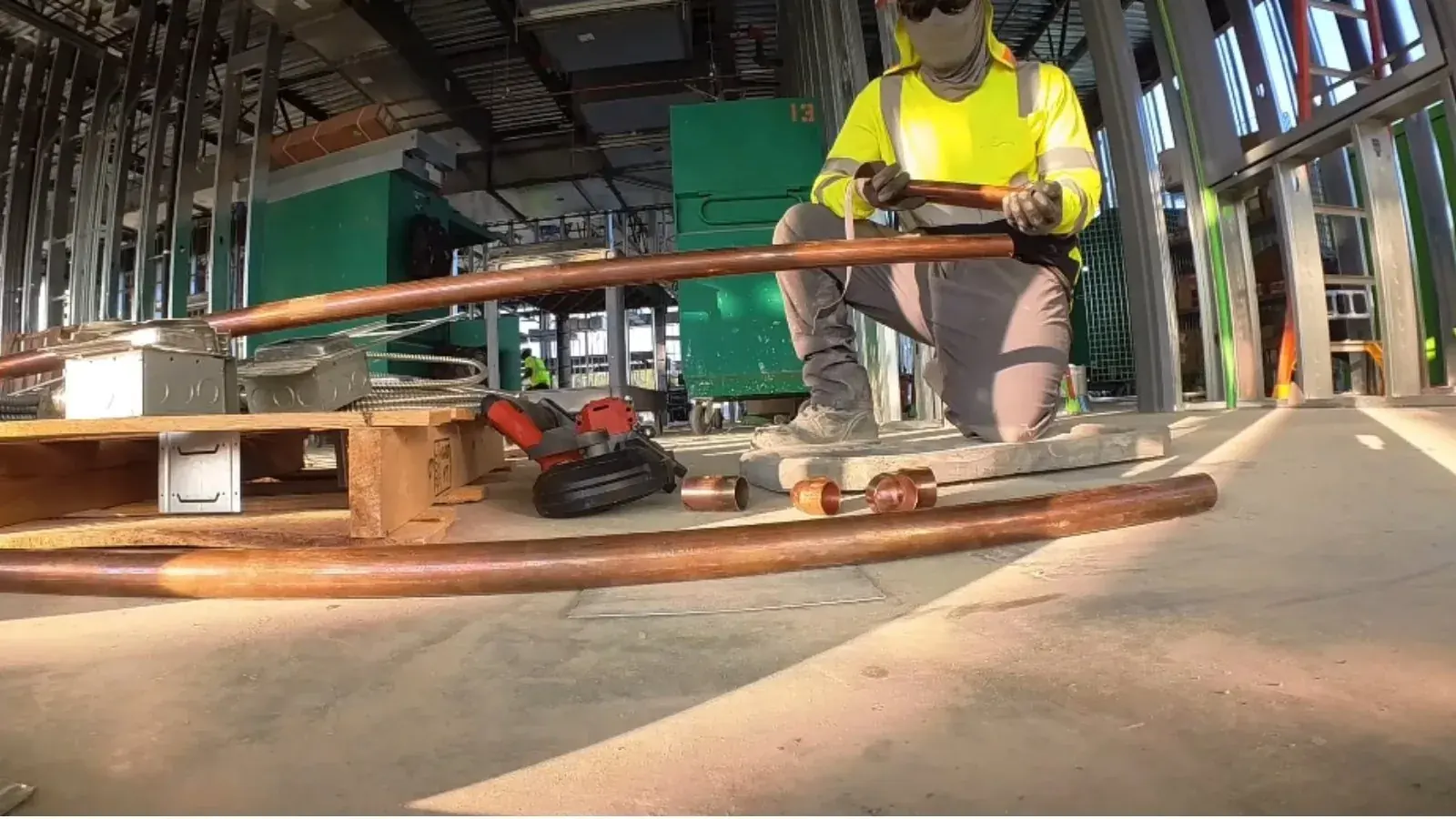
Plumbing a new house means installing every drain, vent and supply line from the ground up. The bill depends on how many fixtures there are, how far apart they are, what the foundation is and which materials you choose. Quotes vary widely, and the variation usually traces to scope and not to anyone padding the price.
This guide is a way to read a plumbing bid for a new build in Douglasville, GA. It lists what a bid should include, the factors that move it and the published permit fees that Douglas County lists. For planned work, our plumbing installation page explains how we approach it.
The three stages of new-construction plumbing
From ground to finish
Each stage is a separate visit with a separate inspection in many jurisdictions.
- 1
Underground rough-in. Drains and sewer connections are installed in trenches before the slab is poured or the crawlspace is closed.
- 2
Top-out or rough-in. Supply, drain and vent pipes are run through the framing before insulation and drywall.
- 3
Trim-out or finish. Fixtures, faucets, toilets, the water heater and appliance hookups are installed after finishes.
- 4
Inspections. Each stage is tested and inspected where required.
What moves the price
The factors in a plumbing bid
A fair bid lists these, or explains why one does not apply.
Permit fees published by Douglas County
Douglas County's 2025 residential plumbing permit application lists a minimum permit fee of 20 dollars and per-item fees. Examples on the form include 2.25 dollars for a sink, lavatory, bathtub or water heater, 2.50 dollars for a water closet, 0.20 dollars per foot for an underground sewer or water service line and 2 dollars per foot for a gas line.
These are the numbers on the form we read, and fees change, so confirm with the county building department before you budget. The point is that permit fees are a small share of the project, and the larger costs are labor, materials and fixtures.
Comparing bids
What a good bid should state
| Item | Why it matters | Red flag. |
|---|---|---|
| Scope by stage | Shows what each visit includes | A single lump sum with no detail. |
| Fixture list | Prevents surprises at trim-out | Allowances that do not match your selections. |
| Materials | Shows pipe type and fittings | Vague wording such as standard pipe. |
| Permits and inspections | Shows who pulls and pays | Permit left to the owner without saying so. |
| Exclusions | Shows what is not covered | No exclusions listed at all. |
| Licensing | Georgia requires a licensed master plumber for a plumbing business | Unwillingness to share the license holder. |
Ask the bidder to explain any line you do not understand. Plumbers who work carefully do not mind questions.
Where owners save money, and where they should not
Owners can save by choosing a compact layout, stacking bathrooms and picking standard fixtures and a tank water heater. They can also save by ordering fixtures early, so the rough-in matches them and no one has to move a pipe.
Where not to save is in the hidden parts. Pipe material, slab drains, vents and the sewer connection are the pieces you cannot easily fix later, and a better pipe costs little in the context of a house.
Timing and coordination
Plumbing sits between the excavator, the framer and the drywall crew, and delays at one stage push the next. Confirm the rough-in dates with the builder so the plumber is not waiting on the slab or the framing, since idle time shows up in the bid.
Order fixtures early. A tub or shower valve that arrives late can hold up an inspection, and a fixture swapped after rough-in may need the stubs moved.
Douglasville: licensing, permits and sewer type
Georgia licenses plumbers through the Division of Master and Journeyman Plumbers. The county application asks for the contractor's state card number, so ask who holds the license on your bid. The county building department at 4655 Timber Ridge Drive, Douglasville, handles plumbing permit applications for the county.
The permit form also asks whether the site is on county sewer or a septic tank. That choice changes the underground work, and it is worth settling early. The Douglasville-Douglas County Water and Sewer Authority is the contact for water and sewer service, and homes in Lithia Springs and the towns on our service areas page may use different providers.
Georgia's state minimum plumbing code is the International Plumbing Code (IPC) with Georgia amendments, enforced locally. New construction is inspected against it at each stage, which is why bids should list permits and inspections.
Planning a new build? Call for a plumber and a clear price.
Frequently asked questions
It depends on fixture count, foundation, distance to utilities and materials, so there is no single number. A bid should list the scope by stage.
Usually the plumbing contractor, but confirm it in writing. Douglas County's application asks for the contractor's state card number.
The 2025 residential application lists a 20 dollar minimum and per-item fees, such as 2.25 dollars for a sink or water heater. Confirm current fees with the county.
PEX is often lower in material and labor, but costs vary and each has trade-offs.
The foundation is usually decided by the builder and the lot. The plumbing is designed to suit it.
We dispatch for planned plumbing installation. Call to discuss your project and get a clear price.
Call and describe the site. Dispatch covers Lithia Springs and the towns on the service areas page, and the permit office depends on the county.