
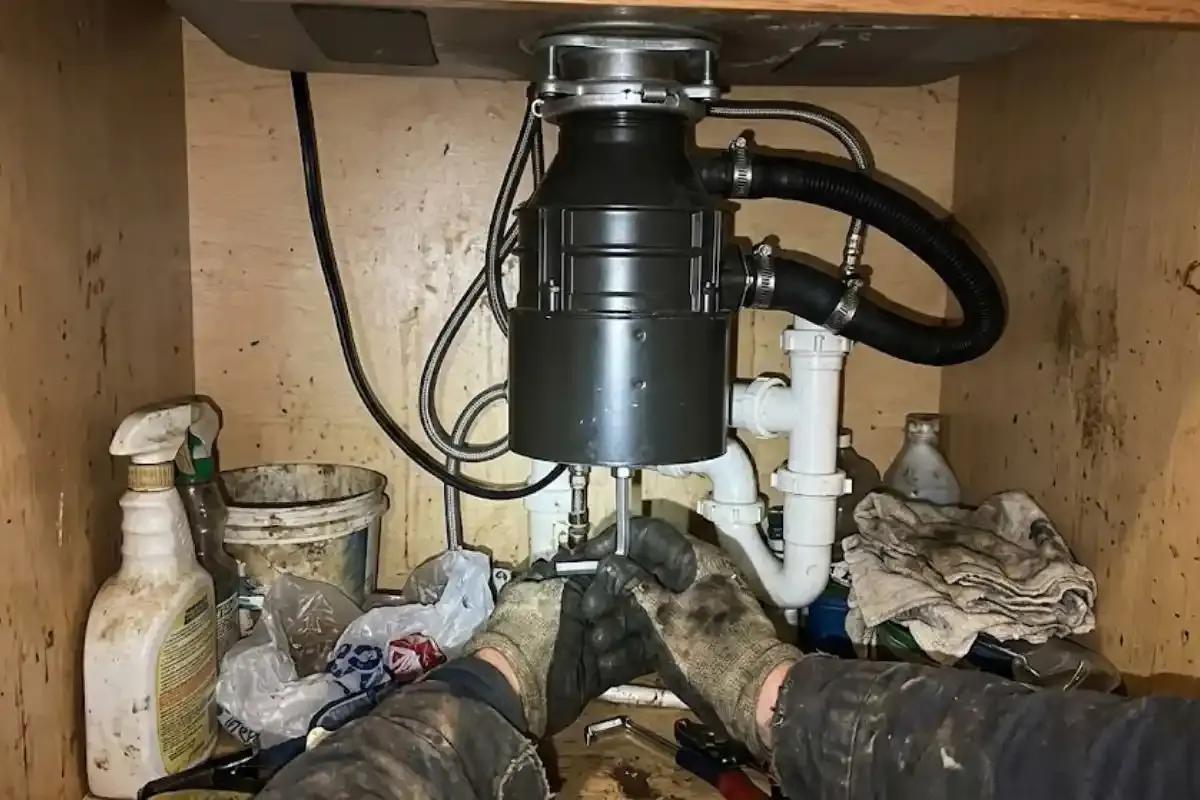
A disposal that hums but does not spin, leaks into the cabinet, or leaves the sink backed up is more than an annoyance in a working kitchen. If it is leaking, turn it off at the switch, run no more water into the sink and put a bucket under the leak. The line is open 24/7 for urgent kitchen plumbing.
Never put your hand in a disposal, even when the power is off at the switch. Cut power at the breaker or unplug the unit before any work, and use tongs for anything you can see.
Disposal emergency: humming, jammed or dead
What the sound tells us
| What you hear or see | Likely cause | What to try or expect. |
|---|---|---|
| Hum but no spin | Jammed flywheel | Rotate with a hex wrench from below, press the reset button. |
| Nothing at all | Tripped reset or dead outlet | Press the reset button, check the breaker. |
| Loud grinding | Foreign object or worn parts | Inspect and clear, replace if worn. |
| Leaking from the bottom | Failed seals or cracked housing | Replace the unit. |
| Leaking from the top flange | Loose flange or failed plumber's putty | Reseat the flange. |
| Leaking from the drain pipe | Loose connection | Tighten or replace the gasket. |
A jam is often a quick fix. A hex wrench in the bottom of the unit turns the flywheel by hand, and the red reset button restores power after a thermal trip. If the problem returns, the motor or bearings may be failing.
What should never go down a disposal
- Grease, oil and fat, which coat pipes and cool into blockages.
- Fibrous foods such as celery, corn husks and onion skins in quantity.
- Coffee grounds in heavy amounts.
- Bones, pits and fruit stones.
- Pasta, rice and potato peels, which swell and gum up.
- Non-food objects.
A disposal is a food waste grinder and not a trash can. Running cold water while it works and for a few seconds after keeps the debris moving. If the drain still backs up, the clog is past the unit and a drain job is called for, see drain cleaning.
Repair or replace a disposal
A disposal that is 8 to 12 years old, or one that leaks from the body, is usually cheaper to replace than to repair. A jam or a loose connection on a newer unit is worth fixing. Horsepower, feed type and noise insulation are the choices when replacing.
Installing a disposal where none existed adds an electrical connection and may require a switch. If a new disposal is part of a kitchen remodel, our plumbing installation page covers the planning side.
What a disposal replacement involves
A swap is a short job when the cabinet is accessible.
- 1
Power off and disconnect. The old unit is unplugged or the breaker turned off, and the drain and dishwasher lines are removed.
- 2
Remove the old unit. The mounting ring is loosened and the unit lifted out.
- 3
Mount the new unit. The flange is reseated with fresh putty and the new unit is attached.
- 4
Connect the lines. Drain, dishwasher knockout and power are connected.
- 5
Test. The unit is run with water and the connections are checked for leaks.
What affects the cost of a disposal repair
You get a clear price before work starts. These are the factors.
Code points for disposals
Georgia's state minimum plumbing code is the International Plumbing Code (IPC) with Georgia amendments, enforced locally. Its trap and drain rules apply to a kitchen sink with a disposal, and the county permit form lists disposals as an item.
Disposal jammed or leaking? Call and we dispatch a licensed plumber.
Frequently asked questions
Yes. The line is open 24/7. Turn off the switch, stop running water into the sink and call.
The flywheel is jammed. A hex wrench from below frees it, and the reset button restores power.
The cause is a loose connection, a failed flange seal or a cracked housing. A leak from the body means replacement.
Many last 8 to 12 years depending on use and care.
No. Grease cools down the line and builds into blockages.
Yes. We install new units and replace old ones, including the wiring and drain connections.